OpenHermit
OpenHermit is an open-source platform for deploying fleets of AI agents as production services. It separates internal state (sessions, memories, skills) into PostgreSQL and external workspace files into per-agent sandboxes, solving the problem of managing agents at scale. It is for developers and teams who need to run multiple agents reliably across channels and infrastructure.
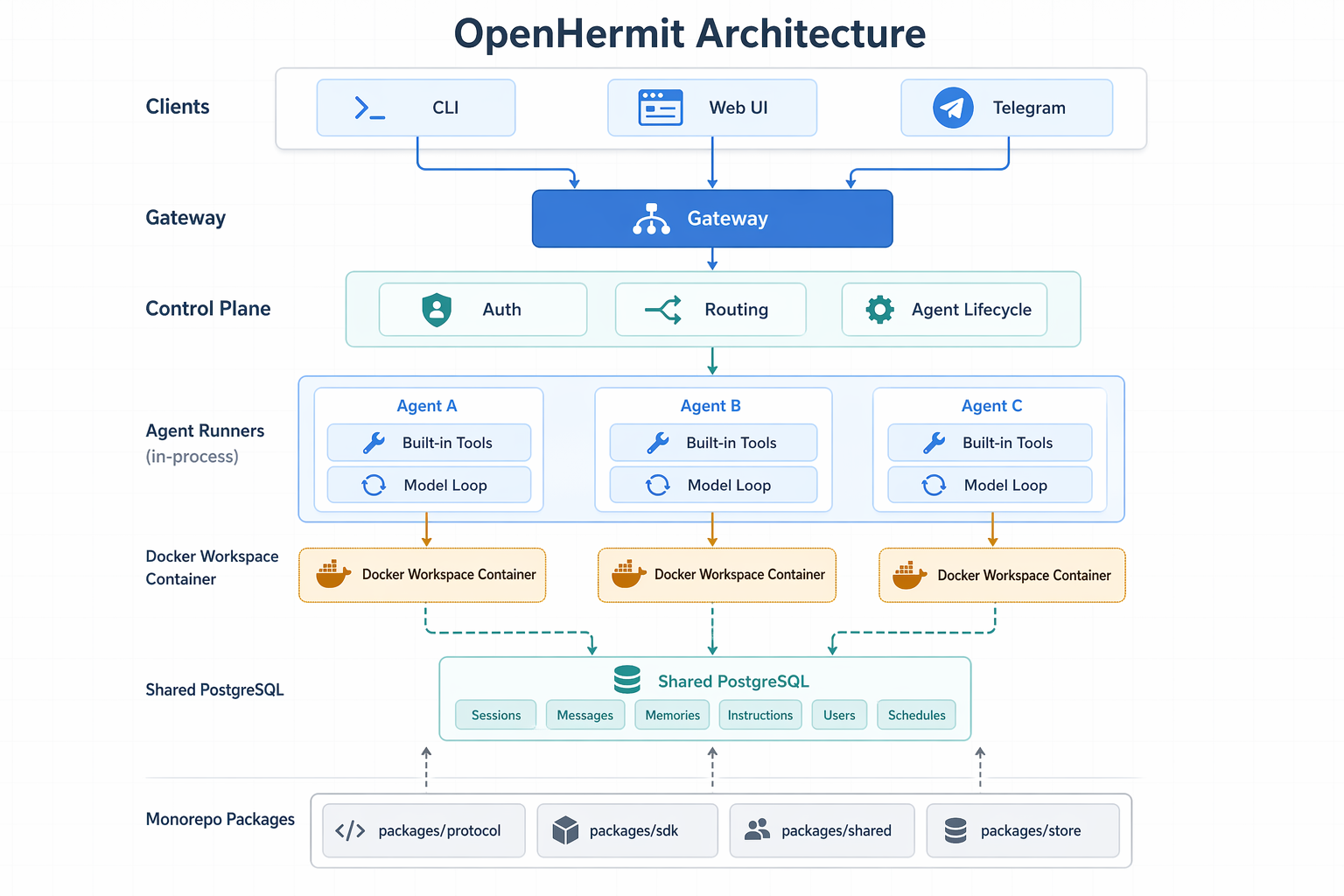
✨ Key features
- Gateway control plane with admin UI
- Postgres-backed durable state for all agent data
- Sandboxed execution via Docker, E2B, or Daytona
- Built-in channels: Telegram, Discord, Slack, CLI, Web
- Centralized skills and MCP server management
- Schedules and automation with cron and one-shot jobs
🎯 Use cases
- Deploying internal agent platforms for teams
- Building SaaS where each customer gets their own agent
- Running fleets of specialized role-based agents
- Automating research tasks with deep research runs
- Integrating agents with messaging channels like Slack and Discord
📦 Installation
🧰 Requirements: Requires Node.js and PostgreSQL. Optional API keys for model providers (e.g., OpenAI) and sandbox providers (E2B, Daytona) depending on configuration.
npm install -g openhermit
This installs both hermit and openhermit.
For local development:
git clone https://github.com/HCF-S/openhermit.git
cd openhermit
npm install
🚀 Usage
hermit setuphermit gateway start
hermit web starthermit status
hermit doctorhermit agents create main
hermit agents start mainhermit chat --agent main⚠️ Good to know
Deep research runs are model-intensive and may require paid model tiers; free tiers often hit token quotas. Also, research currently supports only HTML/text sources and web-only sources, and manual resume after unclean restart.
❓ FAQ
How does OpenHermit handle agent state?
Internal state (sessions, memories, skills, etc.) is stored in PostgreSQL, scoped by agent_id. External workspace files are kept in per-agent sandboxes (Docker, E2B, or Daytona).
What channels are supported?
Built-in adapters for Telegram, Discord, Slack, plus CLI and Web UI. Additional adapters like Signal, WeChat, and WhatsApp can be installed via packages.
Can I use local models for deep research?
Yes, any OpenAI-compatible local server (Ollama, LM Studio, etc.) can be used via a custom endpoint. However, models of 27B+ parameters are recommended for reliable JSON output, and a context window of 64k+ tokens is needed.
How do I manage secrets for agents?
Secrets are stored encrypted at rest in PostgreSQL using OPENHERMIT_SECRETS_KEY (AES-256-GCM). You can set them via CLI: hermit config secrets set KEY value --agent main.
📊 Repository
🤖 Overview, features, install steps and FAQ were generated from the project's README on Sep 4, 2026. Always check the original source before running commands.