NVIDIA Cosmos
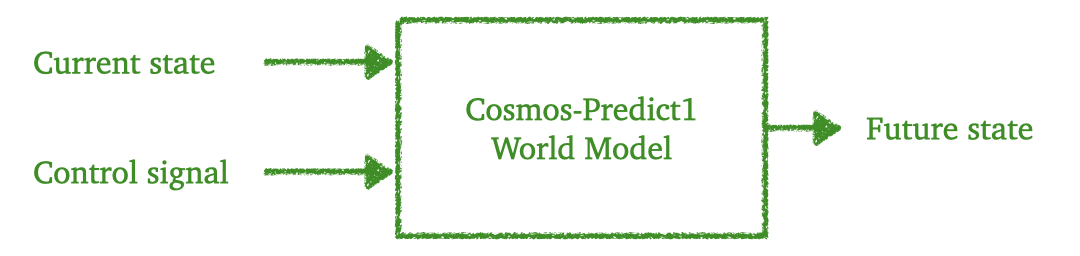
Cosmos-Predict1 is a collection of world foundation models from NVIDIA for predicting future states of visual environments, including diffusion and autoregressive models for Text2World and Video2World generation. It provides pre-trained models, tokenizers, and post-training scripts for Physical AI builders to generate or simulate visual worlds. This repository is no longer actively developed; users are directed to Cosmos 3.
✨ Key features
- Diffusion-based Text2World and Video2World generation
- Autoregressive Video2World generation
- Image and video tokenizers (continuous and discrete)
- Post-training scripts for custom datasets
- Multi-GPU and multi-node support for inference and training
- Includes safety filters via Llama Guard 3
🎯 Use cases
- Generate synthetic visual simulations from text prompts
- Predict future frames from video prompts
- Create multi-view clips from single videos
- Tokenize videos for efficient processing
- Post-train models for domain-specific world prediction
📦 Installation
🧰 Requirements: Requires NVIDIA GPU and CUDA environment; see INSTALL.md for details. Models are available on Hugging Face.
Please refer to INSTALL.md for general instructions on environment setup.
🚀 Usage
Refer to the examples in the repository for inference and post-training. For example, see Inference with diffusion-based Text2World models.
⚠️ Good to know
This repository is no longer under active development and will receive only limited maintenance updates; future work is focused on Cosmos 3.
❓ FAQ
What is the difference between Cosmos-Predict1 and Cosmos 3?
Cosmos 3 is the next-generation platform with stronger world prediction and unified capabilities, while Cosmos-Predict1 is the older version and is no longer actively developed.
What types of models are included?
Diffusion-based models for Text2World, Video2World, and WorldInterpolator, autoregressive models for Video2World, and image/video tokenizers.
Can I post-train the models with my own data?
Yes, post-training scripts are provided for diffusion and autoregressive models, including multi-node support.
What is the license for the code and models?
Code is under Apache 2.0, models under NVIDIA Open Model License; custom licenses available on request.
📊 Repository
🤖 Overview, features, install steps and FAQ were generated from the project's README on Sep 4, 2026. Always check the original source before running commands.