Microsoft physical-ai-toolchain
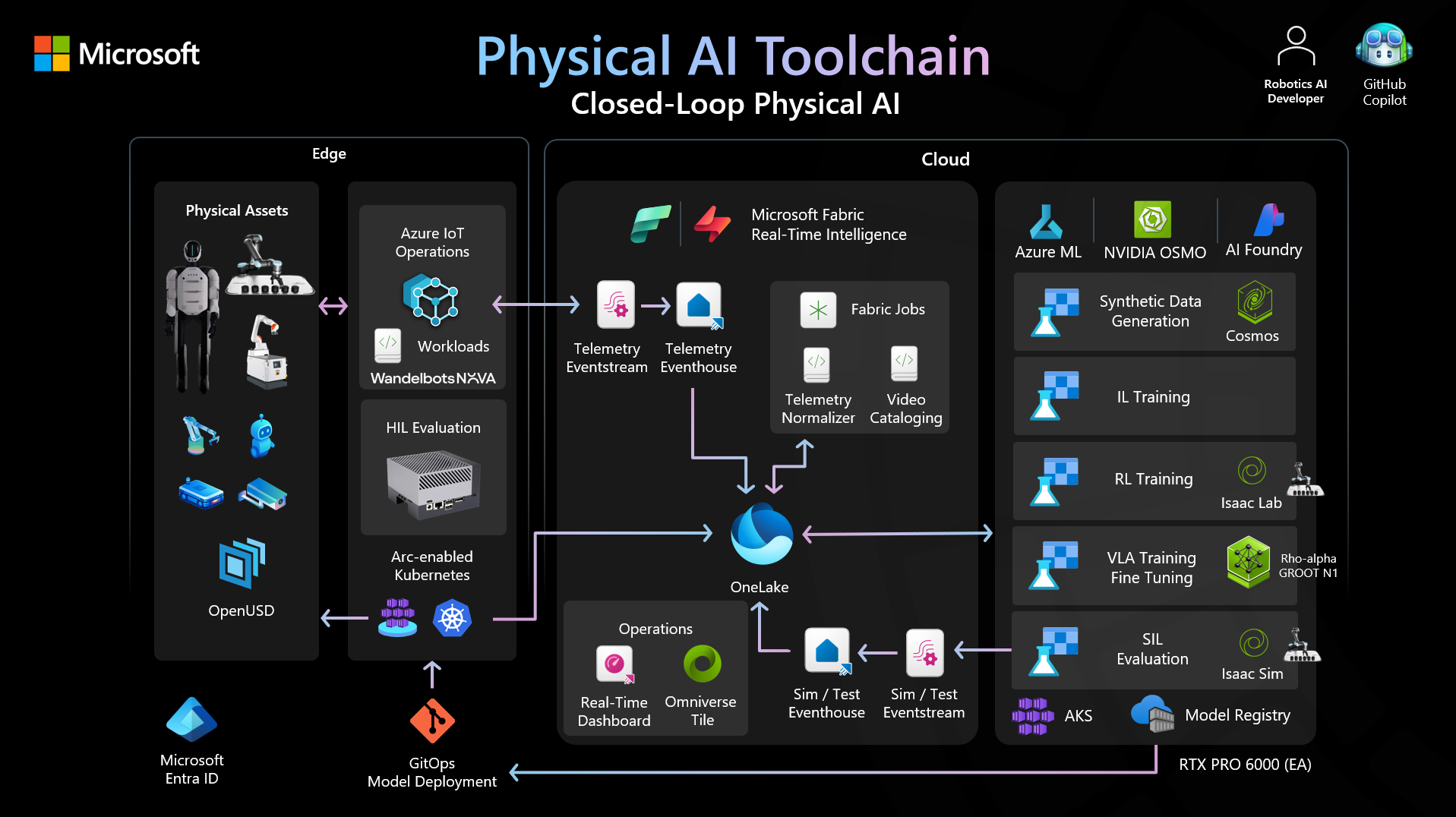
Physical AI Toolchain is an open-source framework that integrates Microsoft Azure with NVIDIA's physical AI stack to automate and scale data curation, augmentation, and evaluation for robotics and physical AI pipelines. It addresses the challenge of operationalizing physical intelligence across fleets and federations of intelligent systems. It is for robotics researchers, platform engineers, and enterprise teams moving from prototypes to production-grade deployments.
✨ Key features
- Infrastructure as Code with Terraform modules for reproducible Azure deployments
- Containerized Isaac Lab training with NVIDIA GPU support
- MLflow integration for experiment tracking and model versioning
- Auto-scaling GPU nodes with pay-per-use cost optimization
- Enterprise security with Entra ID and managed identities
- Agentic pipeline orchestration from data collection to deployment
🎯 Use cases
- Capture demonstrations on a robot and train an imitation policy locally
- Scale to cloud training with Azure ML and NVIDIA OSMO
- Deploy models to edge devices via GitOps
- Orchestrate end-to-end physical AI pipelines with natural language instructions
📦 Installation
🧰 Requirements: Requires Python 3.12, Docker, ROS 2, and optionally an Azure subscription and NVIDIA hardware for cloud and edge components.
./setup-dev.sh
The setup script installs Python 3.12 via uv, creates a virtual environment, and installs training dependencies.
🚀 Usage
./setup-dev.sh
Follow the Quickstart Guide for a local-first walkthrough, then choose your tier for cloud training.
⚠️ Good to know
T5 (Operate / fleet intelligence) is on the roadmap and not yet available; shipping capability spans T0-T4.
❓ FAQ
What is the default starting path?
The default starting path is T0 — Dev, which runs on one laptop and one robot with zero cloud and zero Kubernetes.
Do I need an Azure subscription to start?
No, the T0 — Dev path requires no Azure subscription; cloud components are opt-in at higher tiers.
What is the recommended production tier?
T2 — Pilot is the recommended production tier, which uses cloud training and is suitable for one site at scale.
Can I use agents to orchestrate pipelines?
Yes, agents can turn high-level instructions into executed pipelines, but they are optional; you can start with manual workflows.
📊 Repository
🤖 Overview, features, install steps and FAQ were generated from the project's README on Sep 4, 2026. Always check the original source before running commands.