Future AGI
Future AGI is an open-source platform for building and shipping self-improving AI agents. It combines simulation, evaluation, guardrails, tracing, and optimization into one integrated feedback loop, replacing multiple separate tools. It is designed for developers and teams who need to move AI agents from prototype to production with confidence.
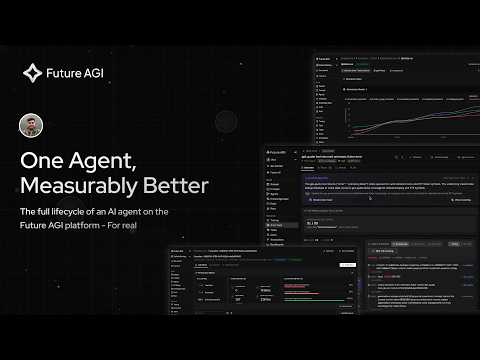
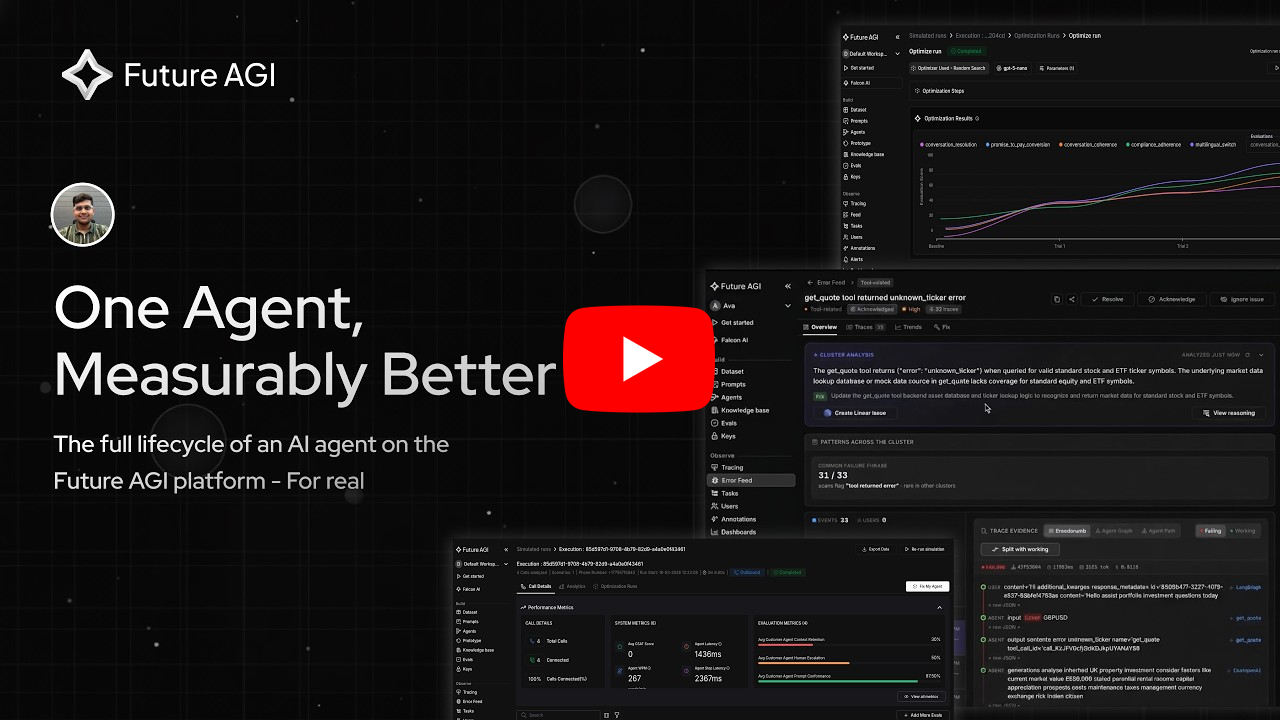
🎬 From First Prompt to Reliable Agent: The Full Improvement Loop, Live | Future AGI · Future AGI
✨ Key features
- All-in-one platform: simulate, evaluate, protect, monitor, optimize.
- Open-source and self-hostable with Apache 2.0 core.
- High-performance Go-based gateway with ~29k req/s and P99 ≤ 21ms.
- OpenTelemetry-native tracing across 50+ frameworks.
- 50+ evaluation metrics and 18 built-in guardrail scanners.
- Six prompt-optimization algorithms included.
🎯 Use cases
- Simulate edge cases and adversarial inputs before launching agents.
- Evaluate production traces for hallucination, PII, and tool-use correctness.
- Protect live agents with real-time guardrails against jailbreaks and injections.
- Monitor agent performance with dashboards and span graphs.
- Optimize prompts using production data and built-in algorithms.
📦 Installation
🧰 Requirements: Self-host requires Docker Desktop or Docker Engine with Docker Compose. Python 3.11+ for SDKs, Node 20+ for TypeScript. Cloud version requires free account signup.
Self-host (Docker)
git clone https://github.com/future-agi/future-agi.git
cd future-agi
./bin/installgit clone https://github.com/future-agi/future-agi.git
cd future-agi
.\bin\install.ps1Open http://localhost:3000.
For production, use ./deploy/setup.sh to generate required secrets and pin the image version.
When upgrading an installation that already contains traces, initialize any inactive unified property catalogs explicitly after the new stack is healthy:
./bin/property-catalog-backfill --execute.\bin\property-catalog-backfill.ps1 -Execute🚀 Usage
Instrument your first agent (Python)
from fi_instrumentation import register
from traceai_openai import OpenAIInstrumentor

register(project_name="my-agent")
OpenAIInstrumentor().instrument()

# Your existing OpenAI code is now traced.
response = client.chat.completions.create(
    model="gpt-4o",
    messages=[{"role": "user", "content": query}],
)
Instrument your first agent (TypeScript)
import { register } from "@traceai/fi-core";
import { OpenAIInstrumentation } from "@traceai/openai";

register({ projectName: "my-agent" });
new OpenAIInstrumentation().instrument();

// Your existing OpenAI code is now traced.
const response = await openai.chat.completions.create({
  model: "gpt-4o",
  messages: [{ role: "user", content: query }],
});
⚠️ Good to know
Nightly release for early testing; expect rough edges. Stable version coming soon.
❓ FAQ
Is Future AGI open source?
Yes, the core is Apache 2.0 licensed and self-hostable.
What are the system requirements for self-hosting?
You need Docker Desktop or Docker Engine with Docker Compose available before running the installer.
Does it support voice agents?
Yes, it supports voice agent simulation and evaluation via LiveKit, VAPI, Retell, and Pipecat.
How do I upgrade an existing installation with traces?
After the new stack is healthy, run the property-catalog-backfill command (./bin/property-catalog-backfill --execute on macOS/Linux/WSL, or .\bin\property-catalog-backfill.ps1 -Execute on Windows PowerShell).
📊 Repository
🤖 Overview, features, install steps and FAQ were generated from the project's README on Sep 4, 2026. Always check the original source before running commands.